Evidence-Based Counseling for Sustainable Well-Being
The practice delivers individualized counseling services grounded in mindfulness and somatic, whole-system practices supporting adults seeking measurable growth.
By integrating current clinical research with compassionate guidance, Rebecca facilitates comprehensive treatment plans that optimize resilience, enhance coping strategies, and promote long-term mind-body-spirit alignment. —
Working with Rebecca — What typically leads clients to work with me are experiences like anxiety, panic, persistent worry or sadness, substance use, or feeling disconnected from themselves. Feeling disconnected can mean feeling out of touch from their physical body or from knowing what they want or need in life, work, relationships, and beyond. These mind-body cues are usually rooted in deeper issues, and are often related to inaccurate beliefs about the self, such as “I am not a good person,” or “I deserve this.” It is well known that the vast majority of our cognitive processes, thoughts, beliefs, emotions, and behaviors occur automatically outside of our conscious awareness. Our minds have impressive ways of defending unconscious content like these negative self-beliefs, and can be hard to detect when looking through the lens of defenses like denial or projection, which are known as our blind spots. Through different practices, like IFS, EMDR, hypnosis induction, and self-inquiry, together we uncover the hidden beliefs, thoughts, and emotions that covertly dictate our lives to live more authentically, value-aligned, and in the present, rather than constantly repeating the past or actualizing our worst fears. I often tell my clients, the past is not your fault, the present is all there is, and your future is right here waiting for you to create it.

Issues I work with —
I have a particular interest in being alongside people as they discover their connection to their true Self, which IFS describes as the essence of all beings and engenders qualities such as curiosity, calm, confidence, compassion, creativity, connection, courage, and clarity. People often come to experience the peace and presence that is always here within themselves through our work, and through the ongoing practices they develop. The practices I share are ones I have personally used to work through my own depression, anxiety, panic attacks, and deeply embedded negative core beliefs, are evidence-based, and often have strong roots in ancient wisdom.
What it feels like working with me -
Clients have told me that I feel different from other therapists because it feels like I care and show up “for more than just the paycheck.” I am grateful to say I get to do a job that feels deeply rewarding and stimulating, and that I would do for free if I did not also have to earn a living. I believe my passion comes from my innate curiosity and also from the deep hurt I experienced from my own complex trauma, internalized negative beliefs, pushy thoughts, and all the related manifestations in my external life. I discovered what I now know as therapy through numerous trials and errors, and eventually through looking deeply and honestly inward, which is what I hope to invite you to do.
What are IFS, ACT, EMDR, and mindfulness?
Mindfulness can be described as bringing your attention and awareness to the present moment without judgment, or with curiosity. While this may sound basic and unrelated to therapy, it not only shown to help improve stress-reduction, emotional regulation, deeper insight into unconscious beliefs, improved focus, better sleep, healthier eating, more enjoyment in any experience, including things like exercise or work, and impacts pretty much everything you think, feel, and do; but mindfulness is also one of the most fundamental aspects of all therapeutic work, including IFS, ACT, and EMDR.
IFS (Internal Family Systems) is a somatic, present-moment approach to exploring various parts or patterns that continuously show up in our lives, often unconsciously. For example, many of us have a critical part that uses harsh feedback to help us improve or avoid disaster in life. This part can cause us to feel stuck in negative thought loops and self-doubt, and stagnate our lives. Through the IFS process, we connect internally with this and other parts and use the relationship with it to help it release this role over to the wise Self, which is at the core of all of us. I sometimes use the analogy of a mean old dog to illustrate this. To build trust with an aggressive dog, we (the wise Self) have to approach gently, slowly, and with compassion and understanding for why this dog learned to be so self-defensive and protective. Over time, with continued compassion, the dog will start to trust and soften its defenses and will quite possibly become a faithful friend and reliable source of protection.

ACT (Acceptance and Commitment Therapy) is an approach that integrates practices of staying in the present moment (awareness of reality), knowing what matters to you (values right now), doing what it takes to align with your present values, observing how the mind often takes you away from, or misinterprets those values, and how to continuously return to present moment clarity and awareness with flexibility and acceptance, which means simply allowing, not necessarily liking, what is here.
EMDR (Eye Movement Desensitization Reprocessing) is an 8-phase, powerful somatic tool for processing trauma and rewiring the brain for safety. It originated using eye movements, but research has shown that various bilateral stimulation (BLS) inputs are effective for reprocessing, including tactile vibrating remotes held in each hand or sounds played in alternating ears. This approach starts with establishing a firm foundation in grounding or anchoring practices, education on adaptive information that was perhaps missed during the original trauma, witnessing the memory of the trauma coupled with BLS, and allowing the adaptive information to reprocess the old traumatic misinformation, which is often a belief held in the present that is no longer accurate.
The present moment is all there is; the past is dead and gone, and the future has not yet happened.
Request a Confidential Consultation
Submit the brief inquiry form to initiate a collaborative assessment and determine how our expertise can address your unique counseling objectives.
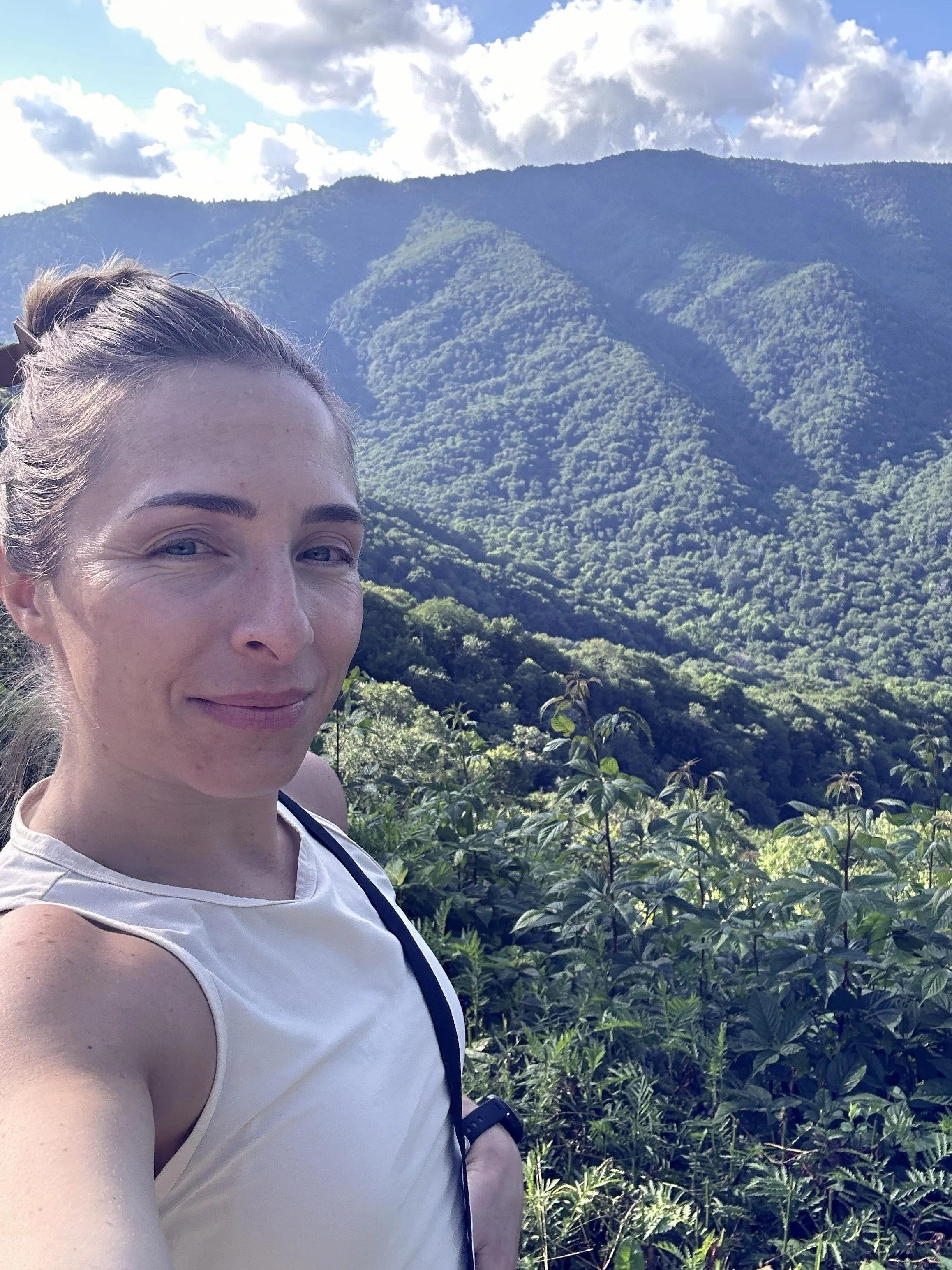
Rebecca is from all over; she was born in FL, did some growing up in CA, and spent most of her youth in Detroit, MI, before making her way to Northeast, NH, and eventually south to NC. She is a first-generation Romanian-American and the first in her family to pursue higher education. Rebecca has a multicultural background and deeply experiences diversity and inclusion as some of life’s greatest gifts. She enjoys reading, rollerblading, deep discussions on philosophy and consciousness, writing, painting, dancing, playing outside in nature, and travelling. She is a strong believer in practicing what we preach and being our most authentic, wonderfully imperfect selves.
Education:
NC - Western Carolina University 2021 - 2023
Master of Social Work
Specialization – Addiction Studies Program
MA - Bay Path University 2015 - 2017
Master of Occupational Therapy
MI - Wayne State University 2008 - 2012
Bachelor of Science in Psychology
Certifications:
Canada - IFS-informed 16-week Comprehensive Training - IFSCA - April 2024
Detroit, MI - EMDR Trained - Coast to Coast EMDR - February 2025
Asheville, NC - Yoga Teacher Training - Asheville Community Yoga - January 2025
Credentials:
Licensed Clinical Social Worker (LCSW) - C019813 - State of North Carolina
Licensed Clinical Addiction Specialist (LCAS)- 29222 - State of North Carolina
Licensed Occupational Therapist (OT/L) - 13791 - State of North Caroli0